Skip to content
Independent, voluntary AI involvement labels

Who really wrote this? — EU AI Act Content Labels & Transparency Scale

One clear label, five levels — from fully human to fully synthetic. A voluntary way to show how content was made, with plain-language EU AI Act context when it matters.

27
member states covered
5
involvement levels
In force
Art. 50 transparency since 2 Aug 2026

AI CONTENT

Involvement label

AI
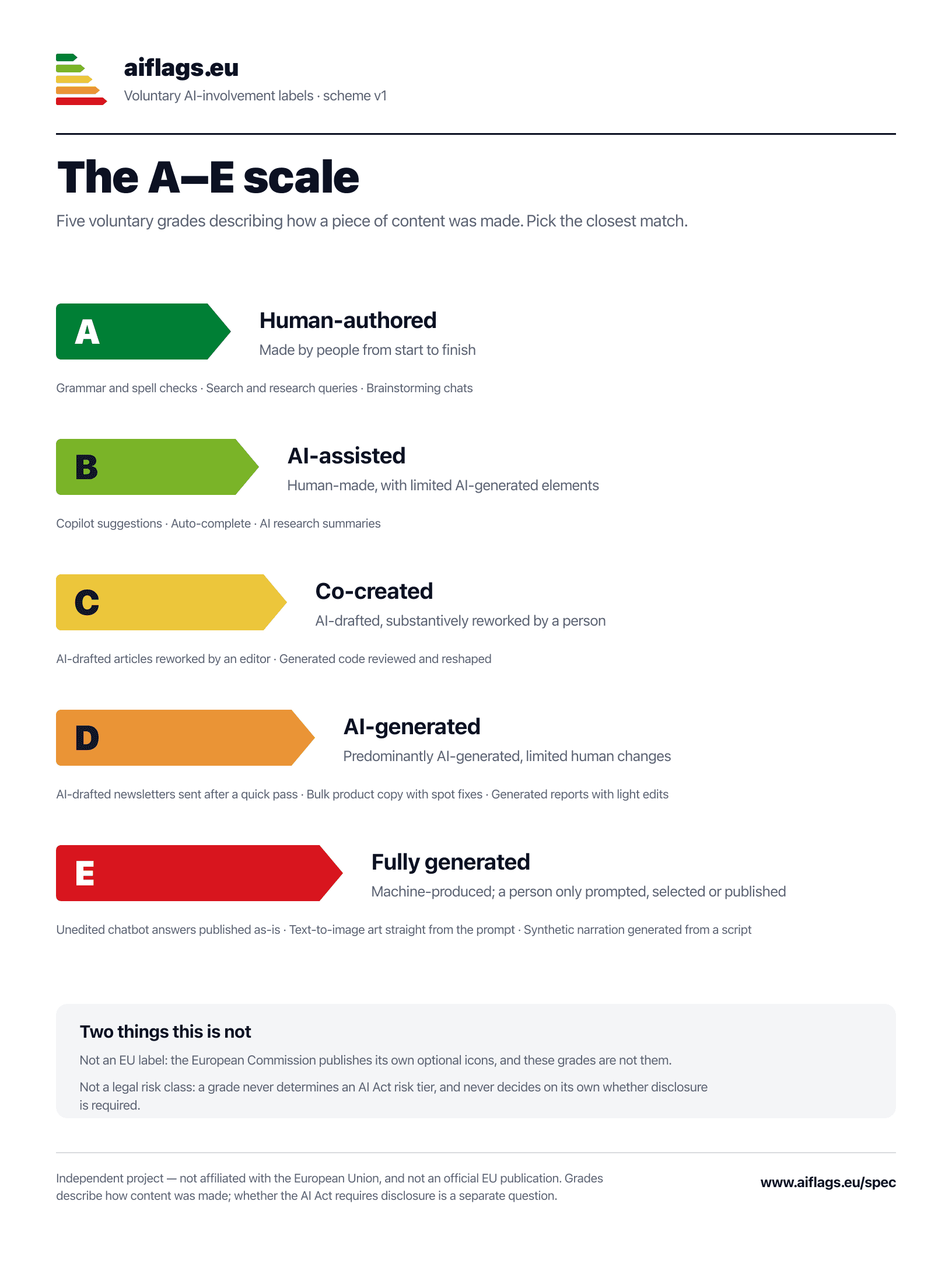
  • Human-authored
  • AI-assisted
  • Co-created
  • AI-generated
  • Fully synthetic
AI involvement100% human wording
Human-ledFully synthetic

Human-authoredA person wrote it. AI was only used for spell-check, a thesaurus, or bouncing around ideas. Nothing AI wrote ended up in the final piece.

The scale

Five clear levels of AI involvement

Pick the closest match for how the content was made. These voluntary grades describe provenance — they are not the AI Act's legal risk classes.

C

Co-created

over 50% AI wording, fully reviewed

AI drafts big chunks, a person directs, edits, and fact-checks. A named human or company carries editorial responsibility.

Typical examples

  • AI-drafted articles with an editor
  • Code generated then reviewed

What the law expects

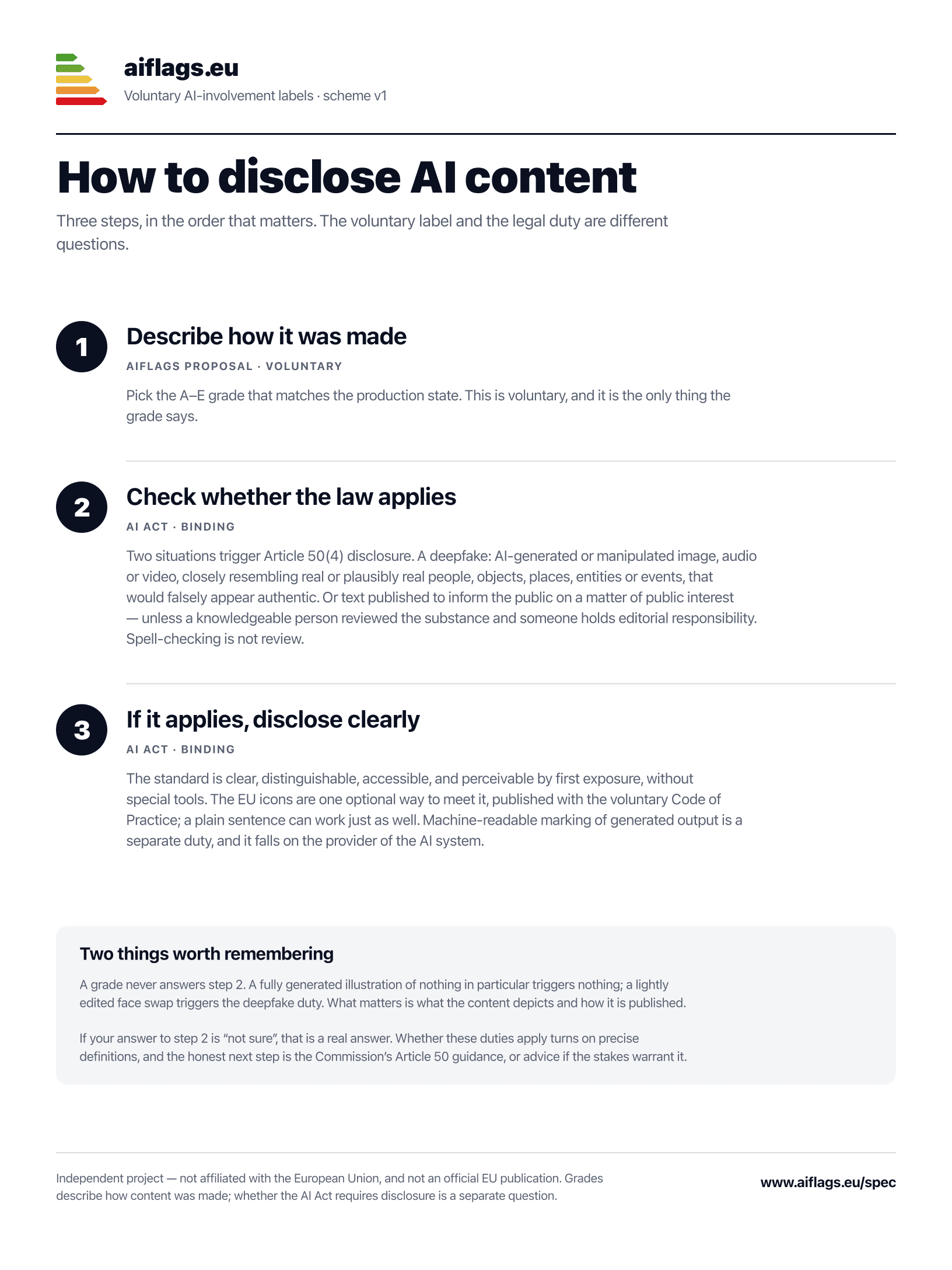
Human-reviewed public-interest text can be exempt from Article 50(4) when a person or organisation holds editorial responsibility.

Find your label

Three questions. One honest flag.

Get a simple suggested grade for how the content was made — not a legal classification. Nothing is sent anywhere.

1How much of the finished piece did AI actually produce?

2Did a person edit, fact-check, and take responsibility for it?

3Does it show real people, places, or events as if authentic?

Your label appears here

Answer the three questions on the left.

Embed

Put the flag on your work

Use the voluntary badge anywhere: hot-link it on the web, or download it for slides, documents, and PDFs. Every badge links back to a plain-language explanation.

1 · Pick your grade

2 · Pick a format

3 · Pick a size

4 · Copy the snippet

<a href="https://aiflags.eu/label/B" data-ai-label="B">
  <img src="https://aiflags.eu/badge/B.svg" alt="AI involvement: B — AI-assisted" height="28" loading="lazy" />
</a>

Live preview

AI involvement: B — AI-assisted — badge on a light background
AI involvement: B — AI-assisted — badge on a dark background

Download for documents

The hot-linked badge updates automatically if the design evolves. The PNG is 56 px tall — place it at 28 px for crisp retina rendering in Word, Google Docs, Keynote, and PDF exports.

Risk tiers

The AI Act sorts uses, not technologies

The same model can be harmless in a video game and illegal in a police van. Europe regulates the use case, on four levels.

Unacceptable risk

Banned

These uses are simply not allowed in the EU, whoever builds them.

Social scoring, manipulative systems, untargeted face scraping, most live remote facial recognition

High risk

Strictly regulated

Allowed, but only with testing, documentation, human oversight, and registration.

Hiring and CV screening, exam grading, credit scoring, medical devices, critical infrastructure

Limited risk

Transparency required

Specific uses carry transparency duties so people know when AI is involved.

Chatbots, deepfakes, public-interest AI text, emotion recognition, biometric categorisation

Minimal risk

No risk-tier rules

The Act does not add use-case rules for most low-risk applications. Voluntary codes are encouraged.

Spam filters, recommendation feeds, video game AI, inventory forecasting

The two scales answer different questions.A–E says how a piece of content was made. The legal risk tiers classify an AI system's use case. A content grade never determines a legal risk tier by itself.

Article 50

Six transparency duties, in plain language

Article 50 applies from 2 August 2026. These duties attach to providers or deployers in specific situations — not to every person who uses AI.

  • Art. 50(1)

    Tell people they are talking to a machine

    Chatbots and voice agents must make clear you are interacting with AI, unless it is obvious to any reasonable person.

  • Art. 50(2)

    Mark synthetic content machine-readably

    Providers of systems that generate synthetic text, images, audio or video must make outputs machine-readable and detectable, where technically feasible.

  • Art. 50(3)

    Disclose emotion and biometric categorisation

    If a system reads your emotions or sorts you into biometric categories, you must be informed before it happens.

  • Art. 50(4)

    Label deepfakes clearly

    Deployers must disclose AI-made or manipulated image, audio or video that constitutes a deepfake.

  • Art. 50(4)

    Flag AI text on public-interest topics

    Deployers must disclose AI-generated or manipulated public-interest text unless it had human review or editorial control and someone holds editorial responsibility.

  • Art. 50(5)

    Make disclosure impossible to miss

    Required notices must be clear, distinguishable, accessible, and given by the first interaction or exposure.

Timeline

When each rule starts to bite

The AI Act arrives in waves. Article 50 covers specific transparency cases from August 2026; high-risk system rules follow later.

  1. 1 Aug 2024

    The AI Act enters into force

    Regulation (EU) 2024/1689 becomes law across all 27 member states.

  2. 2 Feb 2025

    Bans and AI literacy apply

    Prohibited practices become illegal. Providers and deployers must ensure staff have sufficient AI literacy.

  3. 2 Aug 2025

    General-purpose AI rules

    Obligations for general-purpose AI models, governance bodies, and penalties start to apply.

  4. 2 Aug 2026

    Article 50 transparency applies

    Defined transparency duties now apply, including chatbot notices and deployer disclosures for deepfakes and certain public-interest AI text.

  5. 2 Dec 2026

    Grace period for existing generators ends

    Providers of generative AI systems already on the market before 2 August 2026 must meet Article 50(2) machine-marking duties.

    Upcoming
  6. 2 Dec 2027

    Annex III high-risk use rules

    Requirements apply to high-risk uses in areas such as biometrics, education, employment, essential services, law enforcement and migration.

    Upcoming
  7. 2 Aug 2028

    High-risk product rules

    Requirements apply to high-risk AI used in products covered by the safety laws listed in Annex I.

    Upcoming
Print & share

Put it on the wall

Two reference sheets you can hand to a newsroom, a classroom, or a marketing team.

AI content label showing five levels from human-authored to fully synthetic with a risk scale

The label

Single card, energy-label style
PNG
Detailed AI content identification system poster describing levels A to E with risks and examples

The full system

Levels, risks and examples on one sheet
PNG

Reference sheets are illustrative artwork for this project. They are not official European Union publications.

Questions

Straight answers

  • No. aiflags.eu is an independent, plain-language project. The A–E scale is our proposal for making the AI Act's transparency rules easy to apply, modelled on the EU energy label everyone already understands.